
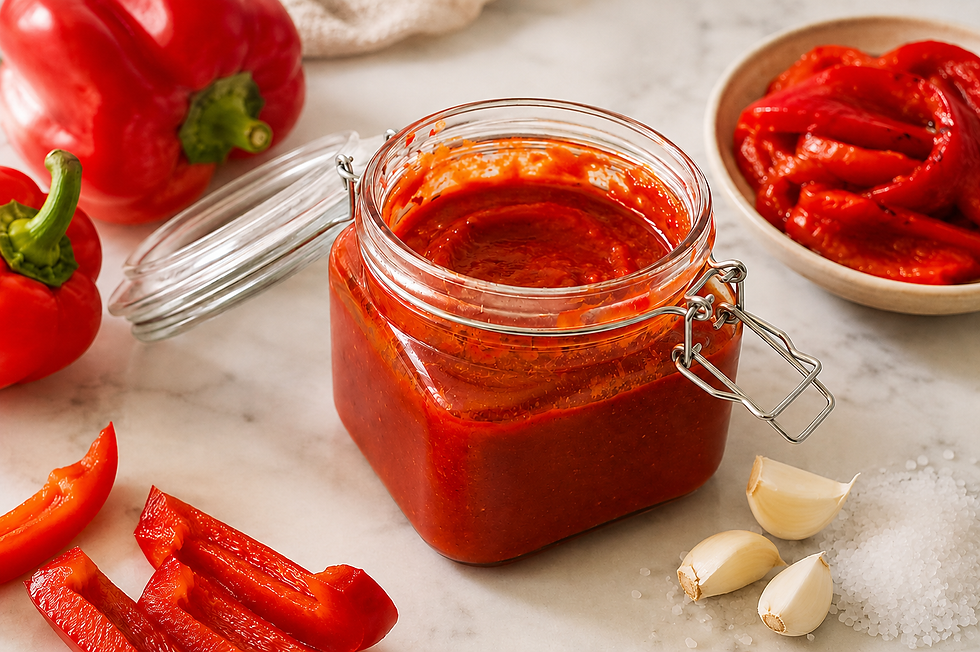
Massa de Pimentão (Red Pepper Sauce)
If olive oil is Portugal's liquid gold, then massa de pimentão might just be its secret weapon.
It's the ingredient that quietly transforms an ordinary marinade into something unmistakably Portuguese. It finds its way into bifanas, roasted meats, stews, seafood, and countless family recipes. It's salty, sweet, slightly earthy, and packed with concentrated roasted pepper flavor.
Traditionally, massa de pimentão is beautifully simple. Just sweet red peppers and salt, patiently left to do their thing overnight before being blended into a smooth paste. That's the version you'll find in many Portuguese kitchens.
Then there's the amped flavor version.
After salting and draining the peppers, I roast them first to deepen their sweetness before blending them with garlic and a little olive oil. It's still unmistakably Portuguese, just with a little more depth and richness. I reach for this version almost every time.
Honestly, once you've made it yourself, you'll probably never buy another jar.
Passport to Portugal
Region: Throughout Portugal
Category: Pantry Staple
Difficulty: Easy
Makes: Depends on which method but generally 1-2 cups
Best Used In: Bifanas, roasted pork, chicken, beef, seafood, stews, marinades, and sandwiches.
Portuguese Word of the Day: Massa (Paste)
Makes Your Kitchen Smell Like: Sweet peppers, garlic, olive oil, and Sunday lunch.
Recipe Snapshot
Prep Time: 20 minutes
Rest Time: Overnight
Cook Time: 20 minutes (roasted version only)
Total Time: Overnight plus about 40 minutes
Why You'll Love This Recipe
Uses just a handful of ingredients.
Better than store-bought.
Keeps for weeks in the refrigerator.
Freezes beautifully.
Adds authentic Portuguese flavor to almost anything.
Ingredients
Simple Massa de Pimentão
4 large sweet red bell peppers
2 tablespoons kosher salt (about 30g)
Flavor-Amped Version
4 large sweet red bell peppers
2 tablespoons kosher salt (about 30g)
2 garlic cloves
¼ cup extra virgin olive oil (60ml)
Method One: Simple Massa de Pimentão
Step 1
Wash and dry the peppers. Remove the stems and seeds. Cut into roughly 1-inch (2.5cm) squares.
Step 2
Place the peppers into a large bowl. Sprinkle evenly with the salt. Mix thoroughly until every piece is coated.
Transfer to a covered container and refrigerate overnight. The salt will draw out a surprising amount of liquid. That's exactly what you want.
Step 3
The next day, drain off all of the liquid. Do not rinse the peppers.
Transfer them to a food processor or blender. Blend until perfectly smooth.
Transfer to a clean sterilized jar. Cover the surface with a thin layer of olive oil if storing for an extended period. Refrigerate.
Method Two: Flavor-Amped Version
Step 1
Prepare the peppers exactly as above. Slice. Salt. Refrigerate overnight.
Drain thoroughly the following day.
Step 2
Spread the drained peppers onto a baking sheet. Roast at 425°F (220°C) for about 20 to 25 minutes, or until softened and beginning to caramelize around the edges.
Allow them to cool slightly.
Step 3
Transfer the roasted peppers to a food processor.
Add:
2 garlic cloves
¼ cup extra virgin olive oil (60ml)
Blend until smooth and silky. Taste. If needed, add another drizzle of olive oil to reach your preferred consistency.
Transfer to a sterilized jar and refrigerate.
Tuga Tip
Don't skip the overnight salting. The salt does more than season the peppers. It removes excess moisture, concentrates their natural sweetness, and helps create the thick consistency that makes a good massa de pimentão.
Portuguese Myth Buster
Myth: Massa de pimentão is spicy.
Reality: Despite the name, traditional massa de pimentão isn't spicy at all. It's made with sweet red peppers, not hot peppers. Its purpose is flavor, not heat.
How We Enjoy It in My Portuguese Casa
I almost always make the roasted version. Roasting the peppers adds another layer of sweetness and complexity that works beautifully in marinades, especially for bifanas and roasted pork. The garlic and olive oil round everything out without taking away from the traditional flavor.
It's one of those little tweaks that's become part of my kitchen.
Good to Know
How long does it keep?
Stored in a sterilized jar and covered with a thin layer of olive oil, it'll keep in the refrigerator for about 3 to 4 weeks.
Can I freeze it?
Absolutely. Freeze it in small portions or ice cube trays so you can thaw exactly what you need.
Can I use sea salt?
Yes. Just use a coarse sea salt rather than fine table salt.
One Last Bite
Every Portuguese refrigerator has a few essentials. Good olive oil. A wedge of cheese. Maybe some chouriço.
And if you're lucky...A jar of homemade massa de pimentão waiting for the next family recipe.